Finding value among risk: interview with Rowan Baker, CFO at Essentra
Finding value among risk: interview with Rowan Baker, CFO at Essentra
 As she approaches ten years in the role of Chief Financial Officer, it’s fair to say Rowan Baker has earned her wings. Having steered the helm at McCarthy & Stone and Laing O’Rourke, Rowan now heads up the finance function at FTSE-listed Essentra.
As she explains in this interview, her approach – built from many years of experience – focuses on mitigating risk while simultaneously driving value, looking for rare and untapped opportunities that contribute to steady and sustained growth. Discover how Rowan puts this into practice and believes in always asking: ‘what else could we be doing?’
Could we start with an introduction to you, Rowan? Tell us about you, your role and your career up to now.
Of course. I’ve held a number of roles throughout my career and worked my way up to the role of CFO. My first experience as a CFO was at McCarthy & Stone, a FTSE-250 retirement housebuilder. Interestingly, I joined McCarthy & Stone as a temp in 2011. Almost exactly five years later, I became their CFO. It just goes to show you never really know how things will work out.
I was part of the team that took the business through its IPO and my career accelerated because of the exciting things we were doing. I was there for nine years until 2020 when I made the move to Laing O’Rourke. That role took me to the next level in terms of international experience and complexity. Construction is very different from house building – you’re managing low margins in a tightly controlled environment, which is not for the faint-hearted.
I never intended to stay out of the public markets for long, so I decided to leave construction and join a more international business with a different footprint. That led me to Essentra, which operates in 28 countries, covering manufacturing and distribution with significant imports and exports.
What differences have you noticed between your roles? How did the CFO role change between the companies you’ve been part of?
When I joined Laing O’Rourke, I expected there to be more similarities than there were with McCarthy & Stone given the synergies between house building and construction. Of course there were some, but overall, it was a completely different environment because of the low margins. We had to be much hotter on costs, driving savings wherever we could, knowing that if our costs went up we couldn’t just raise our prices to compensate – because in construction, prices are fixed on the way in. We had to work much harder to control the environment, plan for the future and anticipate changes. It was a big contrast to the more flexible world of home-building.
Another difference was the way stakeholders treated us. Banks and financiers like housebuilders, because they can secure their investments against assets, whereas construction companies have quite a different balance sheet so cannot give the same level of security. Despite the fact I know the built environment sector very well, I ultimately found myself working in a completely different financial setting.
How did you manage that challenge in your day-to-day role as CFO?
We held a weekly Business Performance Review on Friday mornings, which was a three-hour session in which we went through every individual project. Teams reported on how they were doing, where they were stuck, what the blockers were and whether they needed senior intervention, and we would come away from those meetings with clear actions.
This level of real-time, weekly monitoring was very different to what I was used to previously, where finance had been very much focused on a monthly reporting and forecasting cycle. Instead, we were on the front line, asking where we were that week, what we could be doing to shape outcomes. Finance needed to be on its toes, on top of every detail, providing forecasts and waving the flag when we spotted a problem.
How has that experience shaped your approach moving forward?
Now that I’ve moved back into a higher gross margin business, I’m trying to bring some of that low-margin discipline with me. I meet some resistance at times: people will sometimes say to me, ‘well, we’re doing fine, aren’t we?’ My role is to say, ‘actually, we could be doing so much better if we looked at this, this, and this.’
In construction, you often find yourself mitigating problems, which can create the illusion that your performance is measured by the number of problems you solve. I’m trying to switch that perspective, so that we’re focused on improving financial performance proactively rather than fixing problems as they arise.
It sounds like there’s a strong emphasis on business partnering in your role. What has been your experience of business partnering in finance teams?
Generally speaking, there’s certainly opportunity to be unlocked through improved business partnering in a higher-margin businesses. At Essentra, I’m focusing on defining the value-building blocks needed to reach our targets and ensuring finance is partnering with each one. That means monitoring progress, spotting issues early, and being clear on what success looks like at each milestone. This requires a cultural shift towards focusing on the key value drivers of what we’re delivering.
What do you see as the key value drivers at Essentra?
For me, pricing is the most significant. I’ve picked up responsibility for the pricing function which previously sat more in operations, and now I’m putting in place a series of controls and a reporting structure which will allow us to monitor pricing more efficiently. This will help us to give our regional businesses the tools and visibility they need to be able to raise prices and outperform inflation.
The second big thing is data. We are a data-heavy business – we have thousands of customers purchasing thousands of products – so our ability to analyse this in the appropriate way through insights and analytics is pivotal to business improvement.
Finally, there’s new product development. If we can integrate this area with data and analytics, we’ll be able to see how pricing interacts with new products and optimise pricing structures as soon as they launch.
When it comes to financial reporting, you appear to have seen some substantial changes during your time. How are you adapting to those changes?
You need really good people who know what they’re doing in this space, so attracting the right talent is a key requirement. No CFO can know all the intricacies, so you need a team who are comfortable in their technical expertise and who can help you understand everything.
This is particularly important for us as a listed company, needing to comply with changes in regulations and the latest guidance from the Financial Reporting Council, and I know from experience that it’s important to stay focused.
How do you go about attracting the right people, and how do your purpose and values play into that?
It’s important to make sure the person you’re interviewing demonstrates aligned values and purpose in that interview. In some businesses, values and purposes are obvious – when we were building homes for older people, for example, there was a clear wider benefit. But in manufacturing, it’s less inherent, so I look instead for evidence of strong values through people’s experiences with leadership and culture, and in the quality of their work.
In terms of personal qualities, I look for team players, people who aren’t afraid to roll their sleeves up and get involved, especially when it comes to helping others. But I also want to be sure that candidates understand how they drive value to the organisation. Every role plays a part in creating value – I want people who can see how and where their role contributes.
What does your team look like today? How is it organised?
I manage about 180 people across the world, not just in finance but in associated areas such as data and analytics. In the middle of that is my small core group, who are my day-to-day contacts. I have regional finance teams reporting to me via our Group Operations Finance Director, and then I also have our Group Head of Financial Control and Investor Relations, our Group Head of Tax and Group Head of Treasury who report to me, as well as other project teams.
Looking at our CFO wheel, which area would you say is your biggest challenge right now?
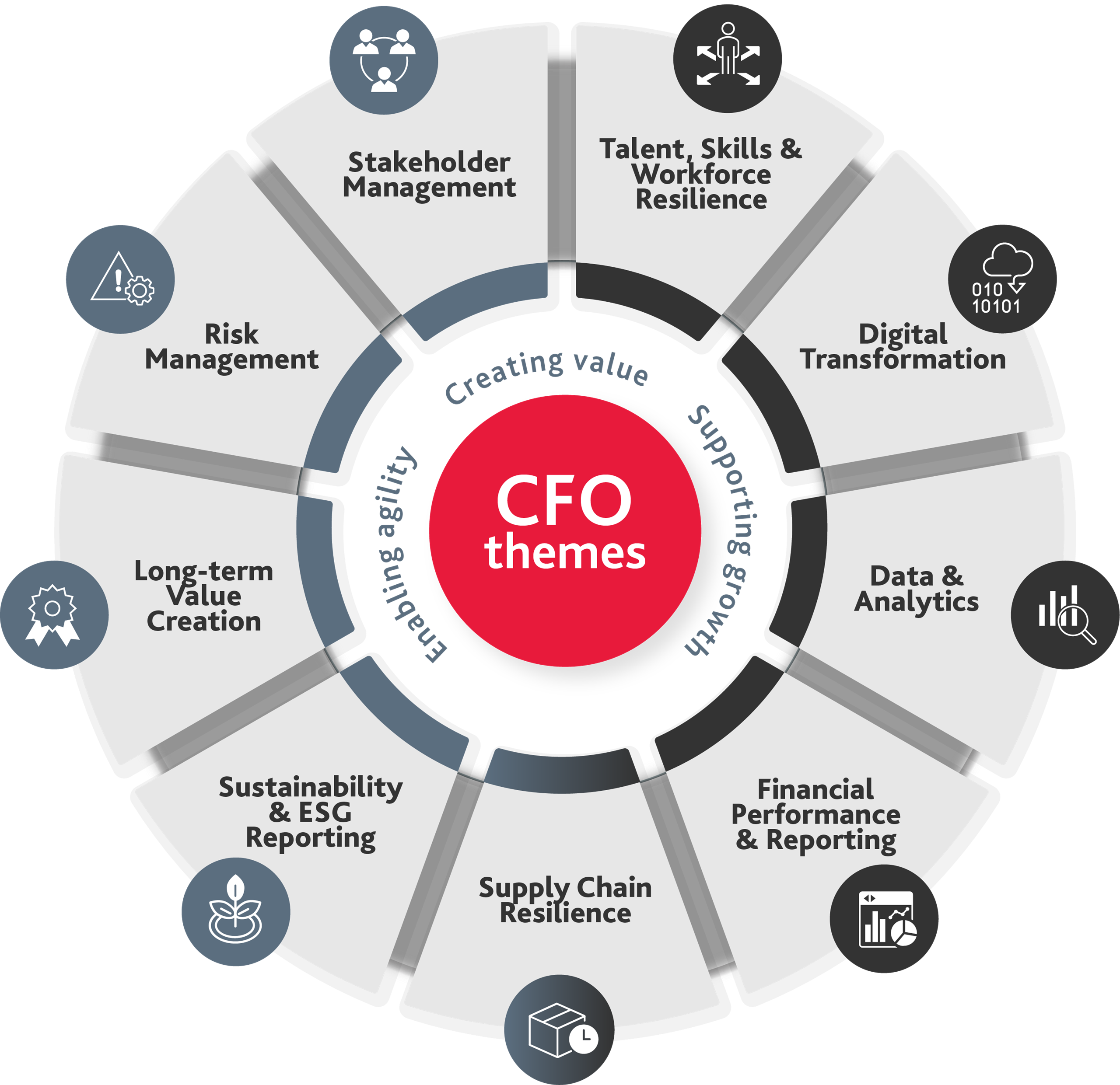
I spend most of my time on financial performance, reporting, data and analytics, long-term value creation and risk management. I also spend a lot of time on talent and workforce resilience.
The area I’d like to spend more time on is digital transformation and AI. I know it’s critical for long-term value creation, but there’s so much else going on. It’s next on my to-do list, though.
What other challenges are you facing?
One of the biggest challenges is the macro environment. It’s changing all the time, and it’s not growth-friendly. The constant challenges tend to make you feel a bit worn down at times.
Another big challenge is around talent. As with a lot of businesses, we’re not in the fortunate position of being able to consistently beat our objectives and pay big bonuses, which makes it hard for us to attract and retain the right talent.
In light of that, the focus right now is on margin improvement and the reporting that goes with that. We’re focusing on the stakeholders and doing whatever we can to show them that things are heading in the right direction, despite the macroeconomic pressure we’re under.
When it comes to risk management, how are you embedding value in that area and what does the governance process look like there?
Provision 29 has driven a renewed focus for us, striving to understand how to embed those material controls and use them to improve the overall quality of risk management conversations, particularly at the senior leadership level. For us, it’s not just about ticking a box – it’s about driving conversations towards better outcomes. We’ve had some great engagement from our Group Executive team when working through the material controls for each principal risk – it has resulted in some good conversations that have really helped to move us forward.
When it comes to risk, I would urge everyone not to be afraid to have those conversations even before you have all the answers. Psychological safety matters – people need permission to challenge and raise concerns without being seen as pessimistic or contrarian. We’re all in the same boat, just trying to stop risks from crystalising and undoing our hard work.
How do you drive change generally in your role?
I’m the catalyst for change in my own arena, so I’m trying to improve the visibility of our performance by making sure we have strong KPI reporting and constantly asking the ‘so what’ question. One issue we have, however, is around ‘data overload’. We have too much data, which can lead to information blindness. Our challenge is identifying which data really matters, and how we can use it effectively to drive value.
You’ve mentioned that your approach to being a CFO is grounded in not only mitigating risk, but pushing to achieve value. Do you therefore see yourself as a Chief Value Officer?
I hadn’t thought of it that way, but yes – it does describe what I’m trying to do!
Learn more about the emerging role of the Chief Value Officer
Download the report: Chief Value Officer – The Important Evolution of the CFO
Chief Value Officer: The Important Evolution of the CFO copyright © 2023 by the Association of Chartered Certified Accountants (ACCA). All rights reserved. Used with permission of ACCA. Contact insights@accaglobal.com for permission to reproduce, store or transmit, or to make other similar uses of this document.