Mastering the inner and outer game
Mastering the inner and outer game
Insights from the Finance Function of the Future roundtable on Developing High Performing Teams
One of the most powerful takeaways from our CFO roundtable was surprisingly simple: finding time for reflection.
Such a simplistic idea and yet, judging by the discussion in the room, one that feels increasingly hard to do. The session focused on creating high performing teams as part of BDO’s Finance Function of the Future CFO to CVO series and was packed with thought provoking discussions between a cross sector of Finance Leaders. The level of engagement put to rest the sometimes lazy stereotype that Finance Leaders are uninterested in culture or people.
Finance functions, like many others, are constantly being told they need to be more strategic and add more value. Yet many have come through wave after wave of transformation programmes focused primarily on speed, accuracy and efficiency often at the expense of innovation, agility and capacity to think. That’s before you factor in the real pressure on time, resources and attention.
So it’s fair to ask: how realistic is the expectation to “create more value” in that context and what does “creating value” actually mean?
How can you create more value?
We asked CFOs how stakeholders currently perceive their finance function — and how they want to be perceived in the future.
Today, the language was familiar: “hard working, good at Excel, reliable, detailed, gatekeepers”. Tomorrow, the aspiration was clear and consistent: “collaborative, trusted partner, critical friend, strategic, commercially insightful”. Businesses differ in where they are on this journey, with some making the move into value and strategic whilst others are still working towards it.
Finance functions want to move from being seen as dependable executors to being value adding partners at the heart of the organisation.
We spent time unpacking what value really means. Value is more than profit. Getting alignment on how your organisation defines value across economic, client, people and societal dimensions give finance teams clarity, purpose and focus. Without that shared understanding, it’s hard to know what to prioritise or where to lean in.
What’s within your control?
One theme came through very clearly: culture matters.
Ultimately, CFOs care deeply about organisational performance. And high performing finance functions are about far more than financial stewardship alone. If that’s the case, finance leaders need to take an active interest in culture, both within their teams and across the wider organisation.
When trust is missing, engagement drops. When engagement drops, productivity follows. And that, in turn, erodes trust even further. The upside of getting this right is powerful:
- Higher energy
- Stronger engagement
- Better collaboration
- And more sustainable performance.
Productivity isn’t just about activity lists and prioritisation — trust and energy are a key part of that equation.
Building high performing teams
Most leaders are clear on the outer game: agility, innovation, adaptability. But the most successful teams invest just as much in their inner game. You can’t have one without the other. This is grounded in over a decade of research into high performing teams by our partner Meta Team, supported by Harvard backed research and assessments across high performing organisations.
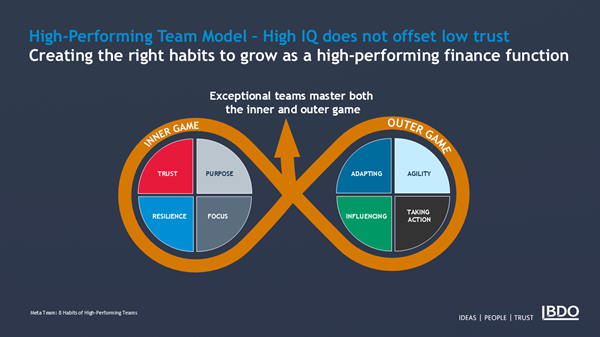
When we asked finance leaders which habits they most needed to strengthen, trust stood out clearly. But so did something else: the ability to find time for reflection (this is a micro-habit of Adapting).
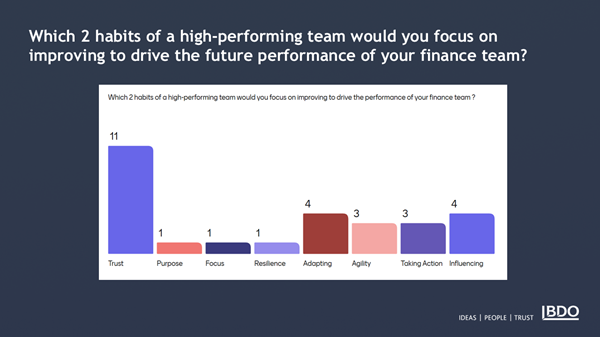
In busy finance environments, it’s easy to live permanently in firefighting mode. Yet to truly add value, teams need to be intentional about finding time for reflection and then learning how to use that time well, together and individually. That is easier said than done in environments where short term delivery pressures dominate and finance functions are constantly managing competing priorities. This is where leaders play a critical role, being brave enough to protect this space, legitimise it, and model it themselves. It should also be on organisations’ radars to consider how work is structured, so productivity and innovation are enabled by design rather than squeezed in around the edges.
Through our culture work, we consistently identify poor collaboration as one of the biggest barriers to performance. The teams that excel don’t leave this to chance. They do what elite sports teams do: they practise together, deliberately flexing the behaviour muscles required for success.
Defining leadership
The responsibilities of the C suite continue to expand. If expectations of senior leaders have grown by around 20%, it’s unrealistic to think any one leader can do everything (which might explain why a finance leader we interviewed as part of our Finance Function of the Future report described the need for Finance Leaders to be ‘contortionists’).
The answer isn’t heroic individual effort, it’s systems leadership. This shift isn’t just structural it’s also personal. It requires finance leaders to rethink not just what they do, but how they see their role: from owning and reporting financial outcomes to collaboratively designing value across the system by deciding where value will come from, backing it with the right capital, resources and talent/people
CFOs don’t need to be experts in culture or AI. But they do need to work closely with those who are, creating true collaboration rather than functional silos. That shift, from informing to genuinely working together is where real value is unlocked.
And the leadership capabilities that matter most? They’re the ones that never go out of fashion: empathy, adaptability, the ability to inspire, and strategic thinking.
If you’re interested in exploring how we’re supporting finance leaders to build high performing finance functions, please contact Sam Seehra.
For more information on our research into the Finance Function of the Future, access to interviews with CFOs and to download our report with the ACCA on The Important Evolution of the CFO, please visit our hub here: Finance Function of the Future.